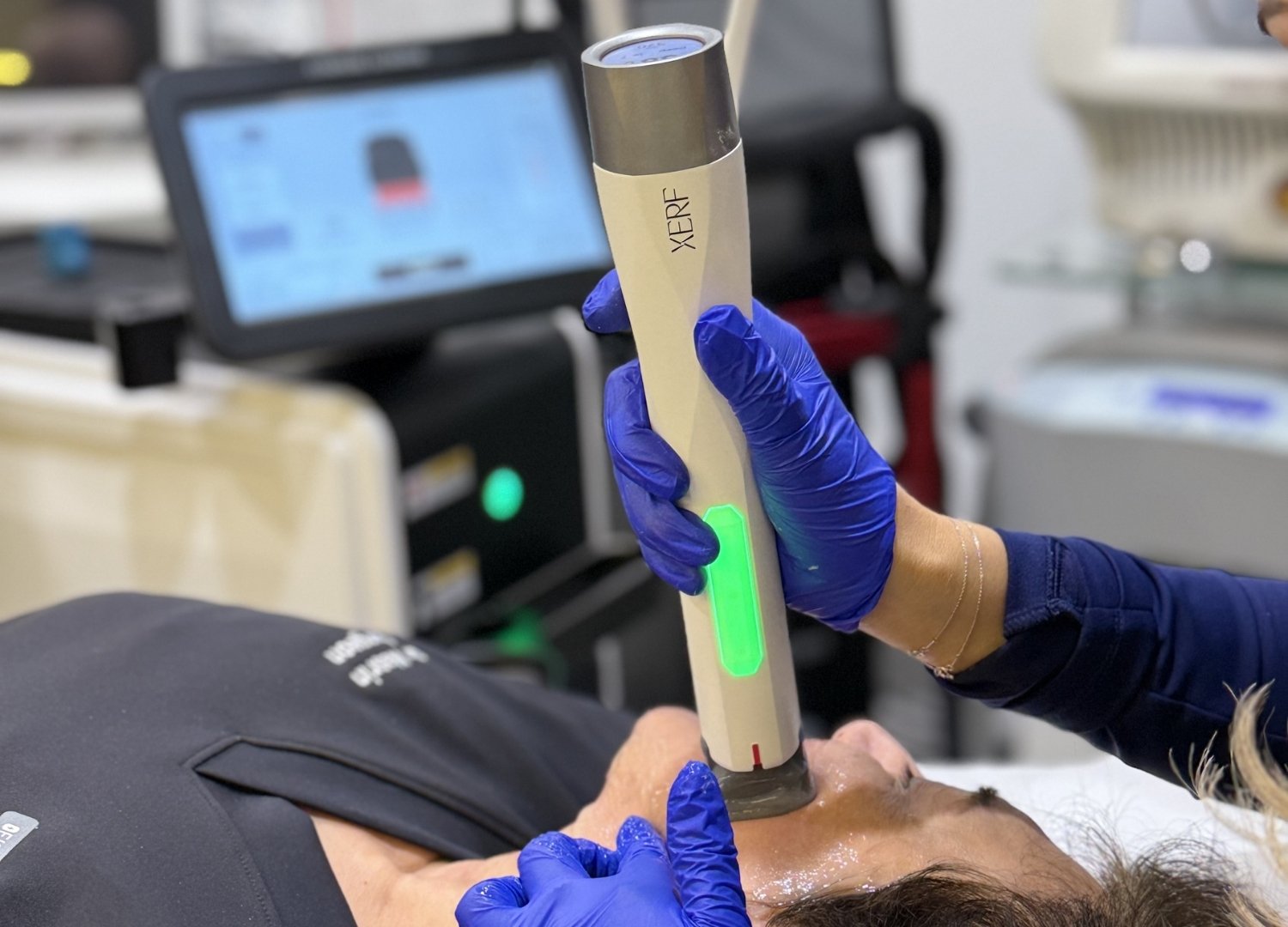
If you’ve been researching non-surgical skin tightening in Brisbane, you’ve likely come across two leading treatments: XERF (monopolar radiofrequency) and Ultherapy (HIFU). Both are non-invasive. Both stimulate collagen. Both improve skin laxity without surgery, needles, or significant downtime. But they work in very different ways, suit different skin profiles, and deliver different results.
This guide walks through how each technology works, who it’s best suited for, what kind of results to expect – and when combining both delivers the best outcome.
Before you read on Cutis Clinic does not have XERF. We’ve written about it because it’s one of the devices patients ask us about most, and because understanding the difference between radiofrequency and focused ultrasound helps you make a better decision. What we do have is Ultherapy and Ultraformer MPT for focused ultrasound, and Potenza RF for radiofrequency. So if radiofrequency is the better fit for your skin, that pathway is still open to you here. This article is about which technology suits you, not which brand name. |
| Quick answer: XERF uses radiofrequency for broader, comfort-focused deep heating. Ultherapy uses focused ultrasound for precise, multi-depth targeting – including the SMAS layer – and doubles as an effective fat-reduction tool for the lower face. The right choice depends on your skin quality, laxity level, and specific concerns. |
How Each Technology Works
XERF — Monopolar Radiofrequency
XERF delivers controlled radiofrequency energy beneath the skin’s surface, heating the deeper dermal layers while a built-in cooling system continuously protects the surface. This dual-frequency heating reaches multiple tissue depths — stimulating collagen contraction and gradual remodelling over time.
Because XERF uses radiofrequency rather than a laser, it is completely colour-blind, making it safe and effective across all skin types and tones. Darker skin types in particular often respond very well, given they tend to have a thicker, more resilient collagen network.
Ultherapy (HIFU) — High-Intensity Focused Ultrasound
Ultherapy uses focused ultrasound to create precise focal points of heat at specific tissue depths — reaching the dermis, the fibro-septal fat layer, and the SMAS (Superficial Musculoaponeurotic System), the layer just above the facial muscle. It heats tissue to approximately 67°C — the optimal temperature for collagen contraction and denaturation.
Crucially, Ultherapy also uses ultrasound imaging before treatment, allowing your practitioner to visualise the tissue layers and precisely target the areas of concern. This imaging capability is unique to ultrasound-based platforms.
A key distinction: Ultherapy is also highly effective at permanently reducing superficial fat deposits in targeted zones such as the jowls and nasolabial folds. This is frequently the primary reason it’s recommended for lower face contouring — not just tightening.
XERF vs Ultherapy: Side-by-Side Comparison
| Feature | XERF RF | Ultherapy HIFU |
|---|---|---|
| Technology | Monopolar radiofrequency | High-Intensity Focused Ultrasound |
| Tissue depth | Multiple dermal depths (broad area) | Dermis, fat layer, SMAS — pinpoint targeting |
| Temperature reached | 40–55°C (sub-optimal for SMAS) | ~67°C (optimal for collagen contraction) |
| Surface cooling | Continuous integrated cooling | No integrated cooling |
| Comfort level | Very comfortable; warmth only | More intense; may require pain relief |
| Fat reduction | Not designed for fat reduction | Yes — effective for jowls & NL folds |
| Skin imaging | No | Yes — pre-treatment ultrasound imaging |
| Primary indication | Mild–moderate laxity, collagen remodelling | Laxity + lower face contouring + fat reduction |
| Sessions required | 1–3 sessions | 1–3 sessions depending on concern |
| Results timeline | 3 months; improves to 6–12+ months | 3–6 months; full result visible at 6 months |
| Downtime | None | Minimal (24–36 hours mild swelling/redness) |
| All skin types | Yes | Yes |
| Thin skin / low facial fat | Use with caution; discuss with clinician | Not recommended — risk of volume depletion |
| Treatment time | 30–60 minutes | 30–60 minutes |
Who is the Best Candidate for Each Treatment?
XERF is ideal if you…
- Have mild to moderate laxity across the face, jawline, or neck
- Want a comfortable, no-downtime treatment
- Are new to energy-based skin tightening
- Have thinner skin or lower facial volume (RF is gentler)
- Prefer a gradual, natural-looking improvement
- Have darker skin tones (responds very well to RF)
Ultherapy is ideal if you…
- Have moderate laxity in the lower face, jowls, or neck
- Want to reduce jowl fullness or nasolabial fat pads
- Have a medium to thick dermis
- Are in the late 20s to mid-50s age range
- Are comfortable with a more intense treatment sensation
- Want to address both laxity and lower face fat in one session
Patient selection is the single most important factor in achieving great outcomes with either treatment. Our clinical team at Cutis assesses dermal thickness, skin quality, degree of laxity, facial fat distribution, and your personal goals before recommending any energy device.
The Key Clinical Difference: Depth, Heat, and Fat
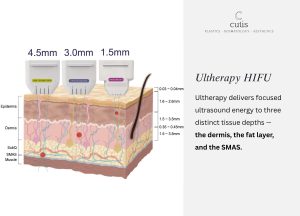
The most clinically significant difference between XERF and Ultherapy lies in temperature reached and tissue depth accessed.
XERF, like all monopolar RF devices, heats tissue to 40–55°C — sufficient to stimulate collagen remodelling and gradual tightening, but below the threshold needed to contract the SMAS. The tradeoff is exceptional comfort and integrated surface cooling.
Ultherapy reaches approximately 67°C — the precise threshold for collagen contraction and denaturation. This is why it can reach the SMAS layer and deliver a more lifting effect in the right patient. It’s also why Ultherapy is more intense to receive, sometimes requiring Entonox (laughing gas) for comfort on larger treatment areas.
The fat-reduction capability of Ultherapy is also clinically distinct. Because focused ultrasound energy is able to permanently destroy focal superficial fat — particularly in the jowl and nasolabial fold regions — it is frequently the treatment of choice when lower face contouring is the primary goal, not just tightening.
XERF = broader, even RF heating for collagen remodelling with superior comfort and no downtime. Best for mild–moderate laxity where skin quality is the focus. Ultherapy = pinpoint ultrasound with SMAS access and fat-reduction capability. Best for lower face contouring and moderate laxity with good dermal thickness.
When Will You See Results?
Radiofrequency
Collagen contraction begins within the first week, though early changes are subtle. More noticeable improvement typically appears around three months as new collagen forms. Results continue building and generally last six to twelve months or longer, depending on your collagen response, age, genetics, and lifestyle.
Ultherapy results timeline
Ultherapy also works in two phases. The first is an immediate contraction of collagen fibres, which produces an early subtle lift. The second phase involves neocollagenesis — new collagen production that builds over two to three months and continues for up to six months post-treatment. Full results are typically visible at the three to six month mark.
Most patients at Cutis Clinic require only one session, though those targeting jowl or nasolabial fat reduction may need two to three sessions spaced over three to six months.
When Combining Both Gives the Best Result
In many cases, using XERF and Ultherapy as part of a layered treatment plan — not necessarily on the same day, but sequenced thoughtfully — delivers superior outcomes. They treat complementary concerns and different tissue depths.
At Cutis Clinic in Brisbane, our most effective combination protocols include:
- HIFUUltraformer + Laser Resurfacing — Ultherapy addresses depth and structure; CO₂, Fraxel, or hybrid laser addresses surface quality, pigmentation, fine lines, and sun damage. Particularly relevant in Brisbane, given the UV exposure most of us have accumulated.
- HIFUUltraformer + Collagen-Stimulating Injectables — HIFU tightens and contours; biostimulatory injectables such as PCL, CAH, or polynucleotides replenish deeper dermal collagen volume. Synergistic and complementary.
- RF + Deep Chemical Peels — RF tightens and contracts from below; Jessner TCA or phenol peels address skin quality and superficial contraction from above. Good where texture and tone both need work.
Your practitioner will review your history, current treatments, and goals to ensure safe sequencing and avoid overlapping recovery periods.
Side Effects and What to Be Aware Of
XERF side effects
Side effects with XERF are typically mild. Temporary redness, warmth, or mild swelling may occur immediately post-treatment but generally resolve the same day. Rarely, temporary changes in skin sensation can occur. Volume loss is not expected — XERF targets collagen, not fat.
Ultherapy side effects
Temporary side effects of Ultherapy include flushed skin, mild swelling, tingling, and tenderness, which typically subside within 24 to 36 hours. Mild bruising and numbness occur rarely. Importantly, Ultherapy is not recommended for patients with very low facial fat or a thin dermis — the fat-reducing effect can cause an undesirably hollow or gaunt appearance in those patients.
Frequently Asked Questions
Do you offer XERF at Cutis?
No. For focused ultrasound we use Ultherapy and Ultraformer MPT, and for radiofrequency we use Potenza RF. We’ve covered XERF here because patients ask about it constantly and the technology comparison is genuinely useful. If radiofrequency is the right answer for your skin, we can deliver that with the device we do have.
Can radiofrequency and Ultherapy be done on the same day?
Generally no. Both cause controlled thermal injury to deeper tissues, and doing both in one session would exceed safe energy thresholds. If you’ve had RF treatment elsewhere, tell us when and where so we can sequence anything we do appropriately.
Is XERF or Ultherapy better for the neck?
It depends on your dermal thickness and degree of laxity. For neck crepiness and general laxity, radiofrequency is often more comfortable and well suited. For moderate neck laxity needing more lift, the ability of focused ultrasound to reach deeper layers may be preferred. A consultation determines which applies to your anatomy.
Can these treatments replace a surgical facelift?
No. Both XERF and Ultherapy are designed for mild to moderate laxity. For patients with marked or advanced skin laxity, surgical options such as a mini or full facelift will deliver results that energy devices cannot achieve. Our team will always give you an honest assessment of what non-surgical treatment can and cannot accomplish for your specific concerns.
How do I know which treatment is right for me?
It depends on your age, degree of laxity, dermal thickness, skin quality, lower face fat distribution, skin type, goals, and tolerance for discomfort. We’re selective about who we recommend Ultherapy for, because patient selection is what separates a good result from a disappointing one. A consultation with our nursing or dermatology team is the first step.
Are results from Ultherapy permanent?
No. Results from both are long lasting but not permanent. Ageing continues, and longevity depends on genetics, age, diet, skin care, sun exposure, and how robustly your body produces new collagen. Many patients still see noticeable improvement two years on and choose follow-up sessions to maintain it.