Weight Loss Surgery and Body Contouring: An Educational Guide for Patients at Cutis Clinic Brisbane
Losing a significant amount of weight can be genuinely life-altering. Blood pressure may settle. Joints often feel less burdened. Sleep can improve in ways people didn’t expect. Some patients describe walking up stairs without thinking about it for the first time in years.
Skin changes may not align with weight loss. Sometimes it does, particularly in younger patients with good elasticity. Quite often, though, it doesn’t. What remains may be folds across the abdomen, looseness along the upper arms, or excess skin on the inner thighs that rubs when walking. For some, it’s mostly aesthetic. For others, it’s practical, including moisture trapped beneath folds, recurring rashes in summer, or difficulty exercising comfortably.

What follows is educational information designed to help you understand what these procedures involve – and what they don’t. It isn’t personal medical advice. Surgery is not appropriate for everyone, and all procedures carry risks. Outcomes vary between individuals.
A Quick Clarification: Weight Loss Surgery vs Body Contouring
Weight loss surgery and body contouring are different.
Bariatric surgery, such as gastric sleeve or gastric bypass, alters the digestive system to assist with weight reduction.
- Body contouring surgery, performed after weight loss, focuses on removing excess skin or reshaping specific areas. This includes procedures like abdominoplasty, brachioplasty, thighplasty, and liposuction to refine body shape and improve contour.
Cutis Clinic Brisbane performs body contouring procedures. Bariatric surgery is undertaken by specialist bariatric surgeons and is outside the scope of our services.
Body contouring surgery does not treat obesity. It does not change metabolism and will not prevent future weight gain. It may address the physical after-effects of weight loss, particularly loose skin and contour irregularities.
Some patients find this distinction confronting. They’ve worked hard and understandably want closure. Surgery can sometimes assist with that, but it is not a substitute for ongoing health management.
Liposuction: Often Requested, Sometimes Misunderstood

Double chin liposuction by Dr Assad Bangash. 8 weeks between photos.
Liposuction is widely performed but requires careful planning. It removes localized fat deposits using a thin tube (cannula) inserted through small incisions. Depending on the area and extent, it may be performed under general anaesthesia or sedation.
Liposuction can be helpful for:
Stubborn fat deposits resistant to diet and exercise
Improving proportion between adjacent areas
Refining zones such as the flanks, lower abdomen, outer thighs, or upper arms
Limitations of liposuction:
Does not remove excess skin
Does not treat obesity
Does not significantly tighten lax tissue
Cannot guarantee smoothness; contour irregularities, asymmetry, and revision surgery are recognised risks
In patients with major weight loss, liposuction alone may not produce the expected improvement. If skin elasticity has diminished, removing fat without removing skin can make laxity more noticeable. Many people assume “less volume equals tighter skin.” In reality, skin behaviour depends on age, genetics, smoking history, duration of weight gain, and tissue quality.
Assessment is individual. There is no universal formula.
Abdominoplasty (Tummy Tuck): More Than Skin Removal

Abdominoplasty & Liposuction by Dr Assad Bangash. 12 weeks between photos.
Abdominoplasty is frequently requested after significant weight loss. The abdomen tends to bear the brunt of weight fluctuation.
Over time, skin stretches. The underlying connective tissue may weaken. In some patients, the abdominal muscles separate (rectus diastasis), particularly after pregnancy or prolonged central weight gain. Even after the weight is lost, the abdomen may appear full or folded.
An abdominoplasty may involve:
- Removal of excess abdominal skin
- Tightening of the abdominal wall
- Repositioning of the umbilicus
- Occasionally, adjunct liposuction for contour refinement
For patients with persistent irritation beneath an abdominal fold – particularly in warmer months – surgery may improve hygiene and comfort. We’ve had patients describe planning their clothing around concealment, or avoiding certain exercises because of movement-related discomfort. Those concerns are real.
Still, it remains major surgery.
Recovery usually involves several weeks of reduced activity. Drains may be required temporarily. A scar along the lower abdomen is permanent, though typically positioned low enough to sit beneath underwear or swimwear. Scar maturation can take 12 to 18 months.
Risks include bleeding, infection, wound healing problems, seroma (fluid collection), scarring, and changes in sensation. Rare but serious complications can occur.
Brachioplasty (Arm Lift): Balancing Contour and Scar
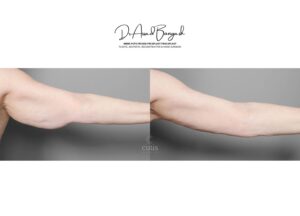
Brachioplasty arm lift by Dr Assad Bangash. 12 weeks between photos.
Upper arm laxity can be particularly visible. Even modest arm movement may cause excess skin to shift. For some people, this affects clothing choices. For others, it becomes a functional irritation — rubbing during exercise or discomfort in heat.
Brachioplasty removes excess skin and reshapes the upper arm. The incision typically runs along the inner arm, extending from near the elbow toward the armpit. Its length depends on the degree of skin excess.
Non-surgical treatments may offer modest improvement for mild laxity. After substantial weight loss, however, they are unlikely to address significant excess skin.
Swelling, bruising, temporary numbness, and tightness are common in the early recovery period. Complications such as delayed wound healing or infection, while uncommon, are possible.
Thighplasty (Thigh Lift): Function Matters
The inner thighs are another common concern after weight loss. Excess skin in this region may cause chafing, skin breakdown, or difficulty with certain movements.
Thighplasty removes excess skin and reshapes the inner thigh. Techniques vary:
- A limited inner thigh lift, with an incision in the groin crease
- An extended lift, where the incision extends down the inner thigh
The choice depends on the distribution and severity of laxity. Liposuction alone may help in mild cases. In moderate to severe skin excess, removing fat without removing skin may worsen sagging.
Recovery involves compression garments and temporary activity restrictions. Swelling can last several months. As with other body contouring procedures, scars are permanent, though they often fade and soften over time.
Who May Be Considered Suitable?
Suitability is determined during a thorough consultation. In general, patients may be considered when:
- Weight has been stable for several months
- BMI falls within a safer surgical range
- Nutritional status is adequate
- Medical conditions are well-managed
- Smoking has ceased
Stability matters. Operating too soon after weight loss may increase complication rates and affect long-term outcomes. It’s not unusual for someone to feel emotionally ready while their body is still adjusting metabolically.
Surgery may improve contour and comfort. It does not replace ongoing lifestyle management. Significant weight fluctuations after surgery can compromise results.
Combining Procedures: Convenience vs Risk
After substantial weight loss, excess skin may involve multiple regions. Some patients consider combining procedures in one operation.
There can be practical advantages – fewer anaesthetics, a single recovery period. But longer operative times may increase risk. Not everyone is suitable for combined surgery. Decisions are based on overall health, operative complexity, and risk assessment.
Safety remains the priority.
Risks, Limitations and Informed Decision-Making
Under AHPRA guidelines, it’s essential to acknowledge that all surgery carries risk. These may include:
- Bleeding
- Infection
- Anaesthetic complications
- Scarring
- Delayed wound healing
- Asymmetry
- The need for revision surgery
Rare but serious complications can occur.
No surgeon can guarantee a specific result. Before-and-after photographs, while useful for discussion, do not represent guaranteed or typical outcomes.
Patients are encouraged to take time before proceeding. A cooling-off period applies in line with regulatory requirements. Seeking a second opinion is reasonable if there is uncertainty.
Recovery: Often Slower Than Expected
If there’s one theme I notice repeatedly, it’s that recovery tends to be underestimated.
Not necessarily the discomfort — though that’s part of it — but the patience required. Swelling can be stubborn. Tightness may persist. Sleeping comfortably can take adjustment. Lifting restrictions may affect work or childcare plans.
Compression garments are usually worn for several weeks. Scars evolve gradually. Emotional adjustment varies; some patients feel relief quickly, others experience a more reflective period while healing.
None of that is abnormal.
A Balanced View
Body contouring after weight loss may improve comfort, proportion, and clothing fit in carefully selected patients. For some, it feels like closing a chapter. For others, it simply isn’t necessary.
Surgery is elective. It involves cost, downtime, and risk. It is not an obligation after weight loss. Choosing not to proceed is as valid as choosing to proceed.
The key is informed decision-making — understanding both potential benefits and limitations.
Consultation at Cutis Clinic

Dr. Assad Bangash is a registered medical practitioner, Specialist Plastic Surgeon (specialist registration in Surgery – Plastic Surgery)
MED0001654645
At Cutis Clinic, Dr Assad Bangash’s consultations are structured to include:
- Comprehensive medical assessment
- Discussion of goals and expectations
- Clear explanation of surgical options and limitations
- Transparent discussion of risks and recovery
- A mandatory cooling-off period in line with regulatory standards
There is no pressure to proceed. Written information is provided, and time for consideration is encouraged. If surgery is not appropriate, that will be discussed openly.
Book a Consultation
If you’re researching weight loss surgery and body contouring in Brisbane and want personalised advice, you can book a consultation with Dr Assad Bangash at Cutis Clinic.