Erbium and CO2 Lasers for Deep Wrinkles: Everything You Need to Know
Key points:
- Erbium and CO2 are ablative resurfacing lasers, meaning they remove and rebuild the skin’s surface rather than working on top of it.
- Both stimulate new collagen production, which is what deep, static wrinkles actually need.
- Erbium suits moderate wrinkles and delicate areas, with a shorter recovery (roughly 5 to 7 days).
- CO2 is generally the stronger option for deeply etched lines, like perioral (smoker’s) lines, but recovery runs longer (7 to 10 days of visible healing).
- The two can be combined in one session for faces with mixed concerns.
- Results build gradually over 3 to 6 months as collagen remodels, and results vary between individuals.
If skincare has stopped keeping up with your wrinkles, you’re in the right place. Retinoids and sunscreen do their bit for fine lines, but once a line has properly etched itself in, whether that’s above the lip, across the forehead or under the eyes, creams tend to soften rather than remove. That’s where ablative laser resurfacing comes in. Here’s a candid breakdown of how erbium and CO2 lasers work for deep wrinkle removal, and how we decide between them at Cutis Clinic Brisbane.
What causes deep wrinkles in the first place?
At its core, deep wrinkling is a collagen problem. Production starts declining in our mid-twenties, and what remains gradually becomes disorganised, particularly with years of sun exposure behind it. Living in Queensland doesn’t help. Add repeated muscle movement, a thinning dermis and tired elastin, and expression lines start staying put even when your face is at rest.
These static wrinkles need something that rebuilds skin structure. Ablative resurfacing appears to be one of the more effective tools we have for exactly that.
What is erbium laser resurfacing and how does it work?
The erbium (Er:YAG) laser operates at a wavelength that water absorbs extremely well, and skin is mostly water. In practice, it vaporises tissue in very fine, controlled layers with relatively little heat spreading into surrounding skin.
That precision lets your doctor tailor depth closely. Lighter around the eyes, where skin can be under a millimetre thick. Deeper where lines have really settled in.
What is CO2 laser resurfacing and how does it work?
CO2 is often described as the benchmark for deep wrinkles, and the reputation has stuck for a reason. It also targets water, but deposits considerably more heat as it goes. That heat is doing real work: collagen fibres contract on the spot, and the skin mounts a more vigorous remodelling response that continues for months.
Most modern CO2 treatments are fractional. The laser creates thousands of microscopic treatment columns and leaves bridges of untouched skin between them, which speeds healing enormously compared with the fully ablative resurfacing of the 1990s. You still get depth where it counts.

CO2 & Erbium laser resurfacing by Dr Nasrin Davarpanah.
Which laser is right for my wrinkles?
There’s no universally better laser, only a better match for a particular face. Broadly:
- Erbium tends to suit: moderate wrinkles, uneven texture, delicate areas, and people who can’t disappear from life for two weeks. Less heat may also lower pigmentation risk in some darker skin types, though this is always assessed individually.
- CO2 tends to suit: deep, established wrinkles (especially perioral lines), significant sun damage, and laxity alongside wrinkling, where the tightening effect is genuinely useful.
Skin type, downtime tolerance, treatment area and your medical history all shift the recommendation, which is why an in-person assessment beats anything you’ll read online. Including this.

CO2 & Erbium laser resurfacing by Dr Nasrin Davarpanah.
Can erbium and CO2 be combined?
Yes, and sometimes that’s the honest answer. An erbium pass to refine the surface followed by fractional CO2 for depth and tightening is one combination approach that may be suggested when deep wrinkles sit alongside more fragile areas. Whether it’s right for you depends entirely on individual assessment.
How many treatments will I need?
It depends on depth and laser choice. A single deeper CO2 treatment may achieve significant change, whereas a more conservative erbium approach might be planned as a series. Your practitioner will map out what’s realistic for your plan specifically.
Is the treatment painful?
The procedure is well tolerated with appropriate anaesthesia. Depending on the depth planned, that might mean strong topical anaesthetic, nerve blocks or other options agreed with your doctor beforehand. Treatment runs anywhere from twenty minutes to over an hour. The first day or two afterwards tends to feel like a strong sunburn. Uncomfortable, manageable.
What is recovery really like?
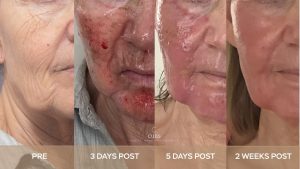
Worth being upfront here. For the first few days the skin is raw, swollen and weepy. Completely expected, not remotely glamorous. You’ll follow a structured aftercare routine, mostly gentle cleansing and occlusive ointment, and sun avoidance is non-negotiable during healing and for weeks beyond.
New skin surfaces within roughly a week for erbium and 7 to 10 days for deeper CO2, followed by pinkness that fades gradually. Collagen keeps remodelling quietly underneath, which is why photos at three months tend to look considerably better than photos at three weeks.
Are the results permanent?
The new collagen is your own tissue, so results are long-lasting and don’t require the ongoing maintenance that some injectable treatments do. Your skin will keep ageing the way skin does, though, and diligent sun protection makes a genuine difference to how well results hold.
Will it remove all my wrinkles?
Honest answer: deep wrinkles can often be substantially softened, but “removal” in the literal, every-trace-gone sense isn’t a promise any responsible clinic should make. Very deep lines may still show some residual trace even after strong treatment, and because results depend on your body’s collagen response, not everyone responds equally. This is exactly what we assess and discuss at consultation.
Are there any risks or side effects?
Like any medical procedure, laser resurfacing carries risks. These include prolonged redness, pigmentation changes (both darkening and lightening), infection, cold sore reactivation, and rarely, scarring or textural change. The risk profile shifts with the laser, the depth and your skin type. Managing it comes down largely to sensible patient selection, appropriate settings and disciplined aftercare, all of which will be discussed openly before any decision is made.
What does it cost?
Pricing depends on the laser, the depth of treatment and the area being treated, so it’s quoted individually after assessment. You’ll find our current pricing on the fee guide, and a full quote is provided at consultation before you commit to anything.

CO2 & Erbium laser resurfacing by Dr Nasrin Davarpanah.
Is laser wrinkle treatment covered by Medicare?
Unfortunately, no. Cosmetic laser resurfacing isn’t covered by Medicare or private health insurance in Australia. Some international policies differ, so it may be worth checking if you’re insured overseas.
Final Thoughts
Deep wrinkles don’t respond well to guesswork, and neither do faces. Erbium and CO2 resurfacing are two of the most effective tools available for established lines, each with genuine strengths and real trade-offs in downtime and intensity.
If you’re unsure which approach suits your skin, book a consultation. Our team at Cutis Clinic Brisbane will assess your wrinkles, skin type and downtime tolerance, and build a realistic plan around your face rather than a template. Book a consultation today!