Ablative vs Non-Ablative Laser: What’s the Difference?
Laser treatments come up in clinic conversations almost daily—and interestingly, the confusion around ablative vs non-ablative hasn’t really changed over the years. The terms sound technical, but the difference is actually quite straightforward once you see how each approach interacts with the skin.
At Cutis Clinic Brisbane, the decision isn’t about choosing the “strongest” option. It’s usually a balance – how much change you’re hoping to see, how much downtime you can realistically manage, and how your skin tends to behave.
What Are Laser Treatments?
At a basic level, lasers deliver controlled light energy into the skin. That energy is absorbed at different depths, depending on the device and settings.
In practice, this may:
- Trigger collagen production
- Soften uneven texture
- Reduce excess pigment
- Improve the appearance of scars or fine lines
That said, not all lasers behave the same way—and this is where the ablative vs non-ablative distinction starts to matter.
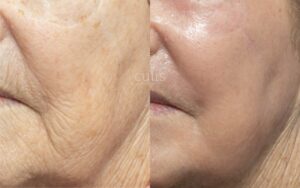
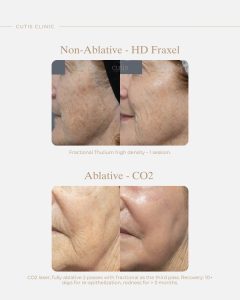
CO2 laser, fully ablative 2 passes with fraction as the third pass. Recovery 10+ day for re-epthelization, redness for >3 months
What Is an Ablative Laser?
Ablative lasers work by removing the outer layers of skin while also heating the deeper layers. It’s a more direct, and arguably more aggressive, way of resurfacing.
You’ll often see these used for:
- Acne scarring that hasn’t responded to lighter treatments
- More established wrinkles
- Significant sun damage
- Skin that’s lost some structural support
The results can be noticeable – sometimes quite quickly. But that intensity comes with trade-offs.
What patients tend to notice
- Skin feels raw and tight for several days
- Redness can persist longer than expected (occasionally weeks)
- Peeling isn’t subtle—it’s usually quite obvious
For some, that downtime is manageable. For others, especially those juggling work or social commitments, it can feel like a lot.
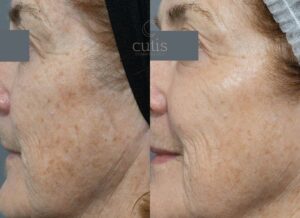
Fractional Thulium high density – 1 session
What Is a Non-Ablative Laser?
Non-ablative lasers take a quieter approach. They leave the skin surface intact and instead heat the deeper layers to encourage collagen over time.
These are often used for:
- Early or mild signs of ageing
- Pigmentation that isn’t too deep
- General skin quality—tone, clarity, texture
- Ongoing maintenance
Results tend to build gradually. Patients sometimes describe it as their skin just “looking better,” without being able to pinpoint exactly when it changed.
What to expect
- Little to no visible downtime
- Mild redness that settles quickly (often within hours)
- A series of treatments rather than a one-off
It’s not that non-ablative lasers are weaker—they’re just working in a different way, and often over a longer timeline.
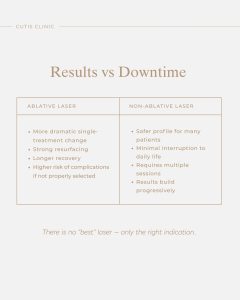
Key Differences at a Glance
| Feature | Ablative Laser | Non-Ablative Laser |
|---|---|---|
| Skin Surface | Removed | Intact |
| Downtime | Moderate to high | Minimal |
| Results | More immediate, noticeable | Gradual, cumulative |
| Sessions | Fewer | Usually multiple |
| Risk Profile | Higher | Generally lower |
Which Laser Is Right for You?
There isn’t a universal “best” option here, which can be frustrating if you’re looking for a clear answer.
In clinic, the decision usually comes down to a few practical questions:
- How visible is the concern (for example, shallow texture vs deeper scarring)?
- How does your skin typically respond to inflammation or injury?
- Are you comfortable with downtime—or trying to avoid it altogether?
- Are you aiming for a quicker result, or something more gradual and low-key?
Interestingly, a combination approach often makes the most sense. For example, starting with non-ablative treatments and layering in more intensive options later—if needed—can sometimes reduce risk while still achieving meaningful change.
Safety and Expectations
It’s worth saying—no laser treatment is completely risk-free.
Some of the more common side effects include:
- Redness and irritation
- Post-inflammatory pigmentation (particularly in darker skin tones)
- Breakouts during the healing phase
- Infection, although this is uncommon with proper care
Results can also be unpredictable. Two patients with similar concerns may respond quite differently, even with the same device and settings.
The Role of Aftercare
If there’s one thing that tends to influence outcomes more than patients expect, it’s aftercare.
Simple measures often make the biggest difference:
- Consistent use of broad-spectrum sunscreen
- Keeping skincare minimal while the skin recovers
- Avoiding active ingredients too early
- Following post-treatment instructions closely
Sun exposure, in particular, can undo progress surprisingly quickly – especially when treating pigmentation.
Final Thoughts
Ablative and non-ablative lasers aren’t competing options so much as different tools. Each has a place, depending on the skin in front of you and the outcome you’re aiming for.
If you’re unsure where to start, a consultation can help map things out – what’s likely to work, what might not be worth your time, and where the trade-offs sit.
And sometimes, the best plan isn’t the most aggressive one – it’s the one you can realistically follow through with.